
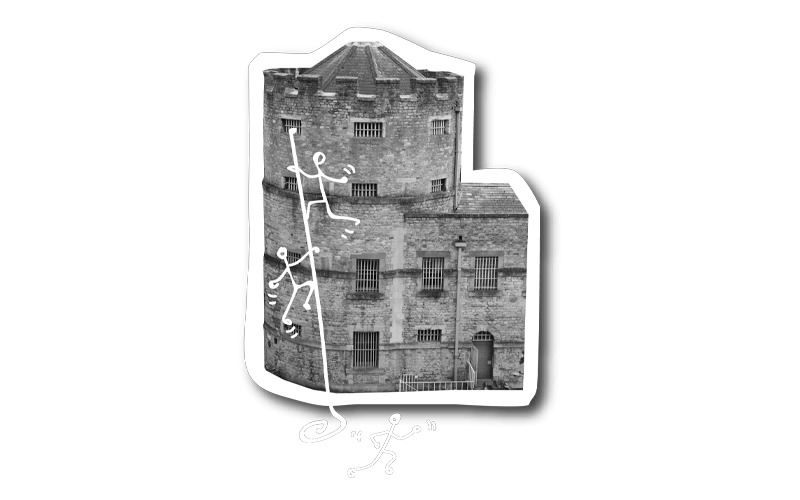
Does prison work?
Prisons exist for several reasons: to punish people; to prevent crime by trying to put people off from either repeating or copying an action; to protect the public, and to get criminals to make up for the bad thing they did.
Dr Shona Minson works in the University of Oxford’s Centre for Criminology and is an expert on prisons. She worked in law before starting her research, which means she knows a lot about different parts of the justice system.
'When I moved into academic research, I was particularly interested in children and families within the criminal justice system and how they’re treated,' she explains, 'and [I] became aware that when children are separated from their parents because their parents are sent to prison, no-one really thinks about what it’s going to be like for them and nobody makes sure that they are being well looked after now that they don’t have their mum or dad taking care of them.'

Effects on families
Dr Minson believes there are some key problems with the prison system which mostly stem from its lack of funding and staffing. As a result, many people who are released from prison often go on to commit further crimes.
'If you think someone is a very dangerous person and you put them in prison, then yes, you’ve got protection for society,' she says.
'But [when it comes to] reform and rehabilitation - i.e. helping people to change their behaviour - prison doesn’t really work for that. At the moment, our prisons are really unsafe. They are hugely overcrowded and understaffed.'
'There has been a reduction of investment in prison staff and the prisons budget itself. At the same time, there has been an increase in more punitive sentencing (stronger punishments). This doesn’t help to achieve anything.'
'People have a view that if somebody has done something bad, send them to prison. You’ve got to ask, "Well, what do we want that person to do because of what they’ve done wrong?" 'If we want them to change, and not do it again, it’s quite unlikely that sending someone to prison is going to do that.'
'Prison itself isn’t a nice place to be - and it’s not a particularly helpful place to be for people who might be suffering from mental health problems. Their situation might improve more with psychiatric treatment and/or support.'
'A lot of the prison population have already suffered huge trauma in their lives,' explains Dr Minson. 'More than 50 per cent of women in prison have said they’ve been abused or subject to domestic violence. Many have not been able to finish their education. A lot have a mental illness. Quite often we’re imprisoning rather than treating people with health problems. I think there’s a lack of understanding of what has caused someone to commit an offence - and therefore how we best move on from that.'

Alternatives to prison
So if prison isn’t necessarily the best thing in all situations, what alternatives are there?
Dr Minson thinks there could be better and increased use of sentences in the community. 'For example, things like electronic tagging whereby offenders are on a curfew....their lives would still be very restricted but they’d be able to live in the community, which means if they’re parents or if they’ve got a job or if they care for elderly people they can still do all those roles.'
'Other types of community sentences include unpaid work, to give something back to the community. People can be fined i.e. people can be made to pay back if [their crime is] about stealing money.'
Prison can affect lots of innocent people indirectly, it’s very expensive, and there are other ways in which people can be punished. On the other hand, it's clear that a prison sentence is appropriate in some cases, for serious crimes such as murder, or in situations where the person is a danger to the public and needs to be in prison for safety’s sake.
'Of course, there are things that need to be punished,' says Dr Minson, 'but are we, as a society, cutting off our nose to spite our face by using this huge amount of money to send people to prison?'
In other words, by trying to punish people, is society unintentionally punishing itself because of the financial cost? But maybe this is a price worth paying to show that crime is taken seriously? What do you think?